Storm damage and emergency tree service
Storm Damage Tree Removal and Emergency Tree Service in the Tri-Cities
We’re Here to Help
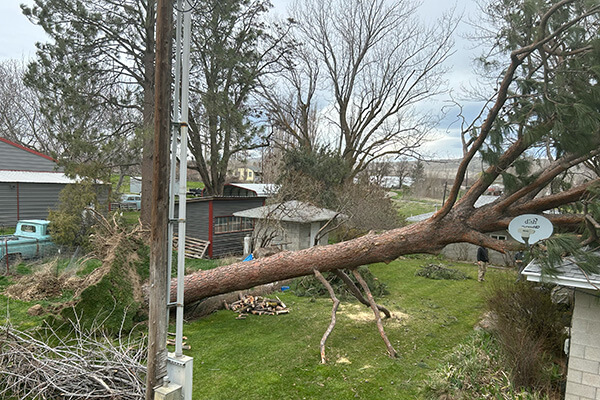
Emergency Fallen Tree Removal
A tree on the house makes everything feel urgent at once. It is a genuinely stressful moment and it is one we work in every year. So here is the part we can take off your plate: call, tell us what happened, and we respond as quickly as we can get a crew moving. We will tell you plainly what the job takes and what happens next. That is what the call is for.
Before you call us
If the Tree Is Touching a Power Line, Call the Utility First.
A tree on an energized line is the utility’s job before it is ours. We do not cut a tree off a live line — the utility de-energizes it, and then we clear it. Making that call first is the fastest way to get the tree off your property, not the slowest.
- Stay at least 50 feet back from any downed, low-hanging, or exposed line, and treat every wire as live even if nothing is sparking.
- Do not touch anything — or anyone — the line is touching.
- If someone is hurt, or there is fire, call 911 first.
- Benton PUD, for Kennewick, Richland, West Richland, Benton City, and Prosser: (888) 582-2176.
- Franklin PUD, for Pasco and Connell: (509) 542-5300.
What happens when you call
Here Is Exactly What Happens When You Call, Including After Hours
Emergency service is available 24 hours a day, seven days a week.
During office hours — Monday through Friday, 8:00 AM to 5:00 PM — you reach us directly at (509) 512-1955. Tell us the address and what the tree is on, and we will tell you what it takes.
After hours, that same number gives you the option to leave a message or reach the on-call person. Leave the address, your name, a number to call back, and what the tree landed on. Trees on a house, a vehicle, a roadway, or a power line get worked first.
We would rather tell you that plainly than promise a live voice at three in the morning and have you find out otherwise.
Storm and wind damage work
Trees Off Houses, Out of Roads, and Down Safely Before They Come Down on Their Own
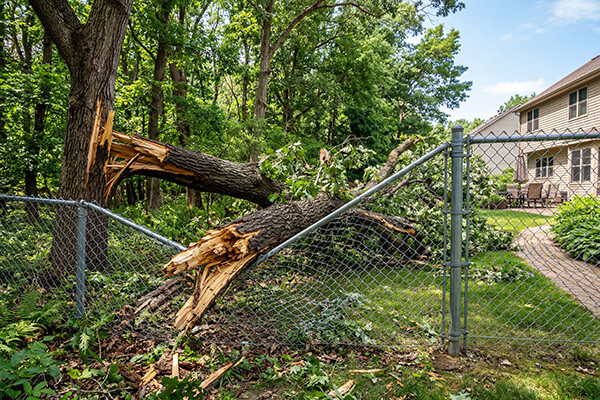
- A tree or a large limb is on your house, garage, shop, or fence.
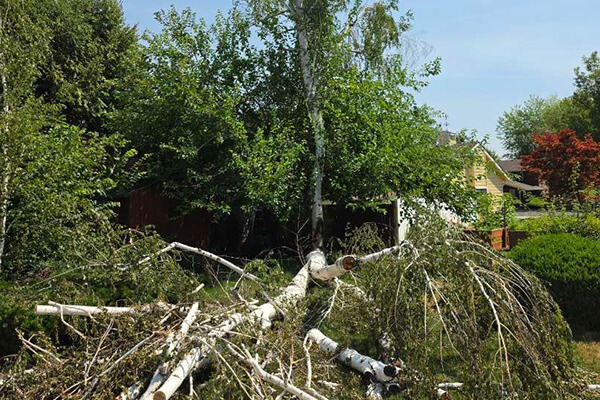
- A tree is on a vehicle, or blocking the driveway.
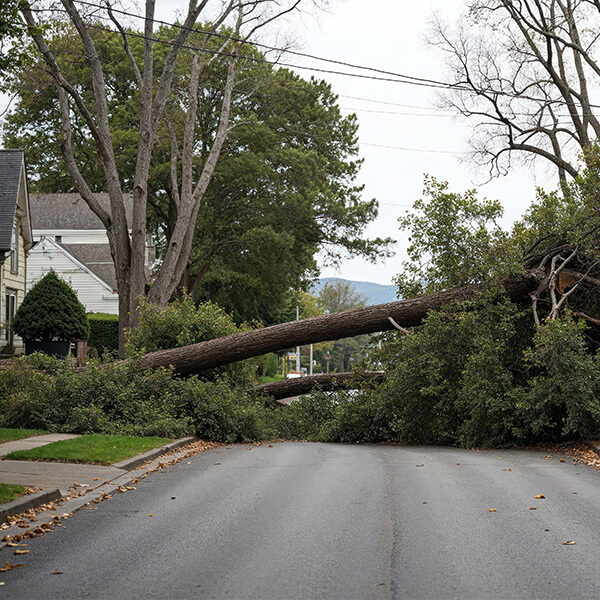
- A tree came down across a road or a shared access.
- A tree is leaning, uprooting, or has a fresh split in the trunk after wind.
- A big limb is hung up in the canopy and has not come down yet.
- The tree is still standing, but you do not trust it through the next blow.
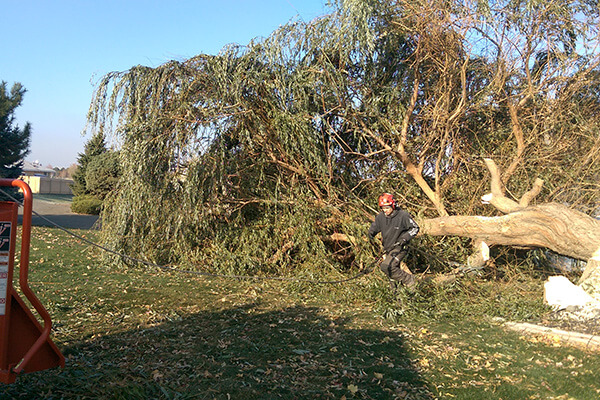
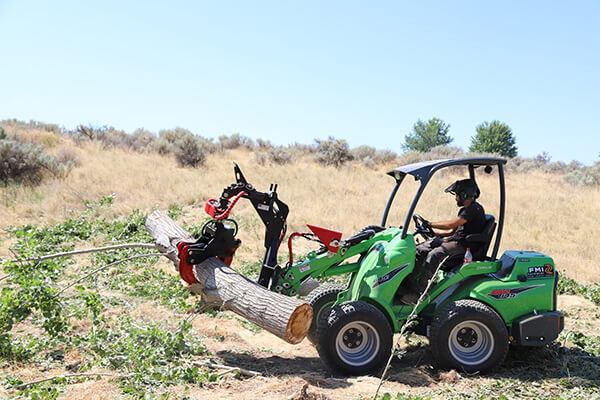
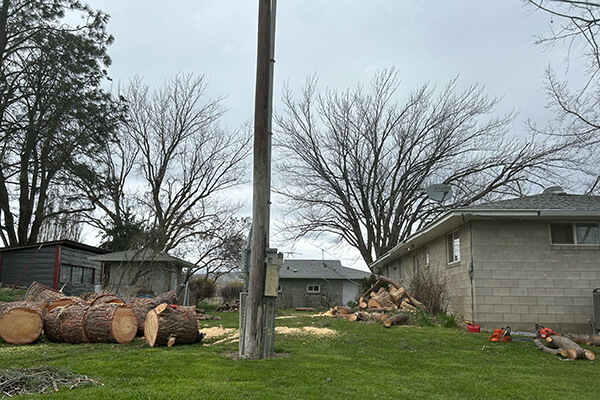
Crews come with the rigging, the saws, and the equipment to take weight off a structure without adding to the damage. Certified arborists on staff direct the work. Everything leaves with us unless you want the wood kept as firewood rounds — say so and we will stack it.
Working with your insurer
Most Policies Cover Emergency Tree Work When the Tree Damages Something
Coverage generally turns on what the tree hit, not on the storm itself. When a tree damages a covered structure — a house, a garage, a fence, a vehicle — homeowners policies commonly cover the damage and the removal of the tree that caused it. A tree that comes down in the yard and hits nothing is often a different answer, and a tree that was already dead or in obvious decline can be treated as a maintenance question rather than a storm claim. Your adjuster makes that call, not us.
Two things help every claim
- Photograph the tree and the damage from several angles before any cutting starts, inside and out. Adjusters ask for it, and once the tree is cut the evidence is gone.
- Get the tree documented while it is still where it fell. If we are on site before you have reached your insurer, tell the crew and they will hold off on anything that is not an immediate hazard.
What a policy typically covers is the emergency work getting the tree off the structure. Hauling the wood away and grinding the stump are usually the homeowner’s responsibility. We write the bid to match: if it helps your claim, we will split the estimate so the emergency removal and the cleanup are itemized separately, in the form your insurer expects.
We are happy to describe the condition of the tree and what the removal took, and to help you get the documentation in order. We do not file claims, negotiate with adjusters, or advise on coverage.
Before the next one
Most Storm Failures Are Visible Months Before the Wind Arrives.
Trees rarely fail at random. They fail at a defect that was already there — a co-dominant stem with included bark, a cavity at the base, deadwood held up in the canopy, roots cut years ago for a driveway or a trench. Wind is what finds the defect. It is not usually what creates it.
The Tri-Cities does not get many wind events, and that is exactly the problem: the ones that arrive are strong, and they arrive in December as readily as in May. There is no season to get ready for. There is only ready or not.
What actually reduces failure risk:
- Thinning and wind sailing, so the canopy passes wind instead of catching it.
- Deadwood removal, so what is already dead is not what falls on the driveway.
- Structural pruning on young trees, which is the cheapest storm insurance there is.
- Cabling or bracing for a split or a weak union worth saving.
- An arborist's read on the trees you already suspect.
If you want a certified arborist to walk your property and tell you which trees are a problem and which are fine, that is a free estimate — not an emergency call. Start with Tree Trimming & Pruning, or with Tree & Plant Health Care if the tree looks like it is declining rather than damaged.
Where we respond
Storm Response Across the Tri-Cities and the Surrounding Communities
Kennewick, Richland, West Richland, and Pasco are our core service area. We also respond in Benton City, Prosser, Burbank, Finley, Connell, and Hermiston, Oregon (Oregon-licensed, CCB #236232).
Top Tree Service · 6101 W Van Giesen St, West Richland, WA 99353 · (509) 512-1955
Storm damage questions
Questions People Ask After a Storm
Do you really offer 24/7 emergency service?
Emergency service is available 24 hours a day, seven days a week. Our office hours are Monday through Friday, 8:00 AM to 5:00 PM, and during those hours you reach us directly. After hours, the same number — (509) 512-1955 — gives you the option to leave a message or reach the on-call person.
A tree fell on my house. What do I do first?
Get everyone out of the affected rooms and stay clear of any power line the tree is touching. Call 911 if anyone is hurt or there is fire, and call the utility if a line is involved. Then photograph the damage before anything is moved, call your insurer, and call us.
My neighbor's tree fell on my property. Who is responsible?
In most cases your own homeowners policy handles damage to your property, whatever grew the tree — that is what it is for. It can change if the tree was already dead and the owner had been told about it. Ask your adjuster. Either way, we can remove it and document what the tree looked like.
Will you cut a tree off a power line?
No. A tree in contact with an energized line is utility work until the line is de-energized. Call Benton PUD at (888) 582-2176 or Franklin PUD at (509) 542-5300, and call us at the same time — we will be ready to clear the tree as soon as the line is safe.
Can a storm-damaged tree be saved?
Sometimes. A tree that lost a limb usually can. A tree that split at the trunk, lost more than about half its canopy, or lifted its root plate usually cannot. That is the call a certified arborist should make on site, and we will tell you straight either way — including when the answer costs us the removal.
Do you charge more for after-hours calls?
Emergency work is quoted on what the job takes — the size of the tree, what it landed on, and what has to be protected getting it off. You will know before we start. Estimates are free.
We are ready when you are
A Tree Down Is an Emergency. A Tree You Are Worried About Does Not Have to Become One
If it happened, call. If it has not happened yet, let a certified arborist look at the trees you already suspect.
Request a Free Estimate
Fill out the form below, and we’ll get back to you as soon as possible.